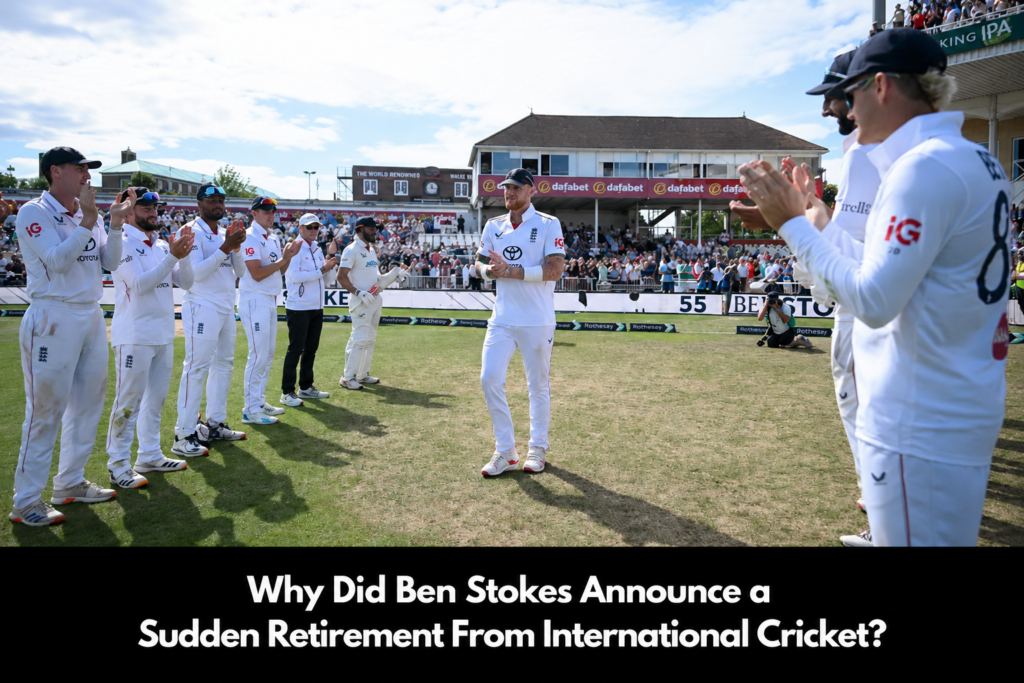
Cricket has seen many retirement announcements. Planned farewell tours. Carefully worded press releases. Emotional send-offs with months of notice and standing ovations on home soil. Ben Stokes did none of that. On the fourth day of a Test match at Trent Bridge, in the middle of a bowling spell, the announcement came. No warning. No farewell tour. No statement from Stokes himself quoted in the ECB’s release. Just a decision, made and communicated before the start of play, and then the cricket continued.
The cricket world stopped. The crowd rose. And then he took a wicket off the very next ball, because that is who this man is.
The question now, as tributes pour in from every corner of the sport, is the one Stokes himself told his teammates could “wait”: why? Why now? Why like this? Why not next year, after one more Ashes series? The honest answer is that Stokes gave no specific public reason. And this piece does not claim to know. But what it can offer is an honest look at the kind of forces that accumulate in a career like his, the kind that eventually lead even the strongest people to know, with absolute certainty, that the time has come.
When A Champion Knows It May Be The Time To Leave
There is a particular form of self-knowledge that only elite athletes possess. It is the internal compass that tells them, before the outside world can see it, that a chapter is over. It does not always come at the point of physical decline. Often, it comes at a crossroads that only the person standing at it can fully feel. Stokes, by all accounts, did not announce his retirement because he was asked to. He announced it because he had decided. The distinction matters.
A man who plays cricket the way Stokes plays cricket does not leave a ground because someone pushed him. He leaves because he chose to.
What brings a cricketer to that moment is almost always a combination of things that have built up quietly over time, one on top of the other, like bricks, until the load is too heavy to carry further. No single brick breaks a wall. But the weight, eventually, makes itself known.
The Physical Weight of 15 Years
Benjamin Andrew Stokes did not play cricket gently. He bowled fast for long spells on flat pitches in sweltering heat. He threw his body into the field without calculation. He batted with the controlled fury of someone who had something to prove on every single delivery. That takes a physical toll that is difficult to put into words and impossible to put into numbers.
In December 2024, during a Test series in New Zealand, Stokes suffered a torn left hamstring. The injury required surgery in January 2025 and ruled him out of cricket for months. He had also sustained a torn shoulder muscle during the India Test series in 2025, which forced him out of the final Test. These were not small setbacks. These were reminders, delivered with increasing frequency, that the human body has limits, and that Stokes had been testing his for a very long time.
For any cricketer of his style and intensity, this kind of accumulation is significant. The body that once bounced back in a week begins to require a month. The spells that once came naturally now demand a calculation about what they will cost. The innings that once flowed freely now require a mental negotiation that never used to exist. For someone who plays as spontaneously and as ferociously as Stokes, that negotiation is corrosive.
ALSO READ: The End of an Era of Dominance: Benjamin Andrew Stokes Bids Goodbye to Cricket
The Mental Cost of Leadership
Since April 2022, Stokes has not just been a player. He has been a captain, a philosophy, and a movement. Bazball was not a tactic. It was a culture, and he was its embodiment. When England won, he won. When England lost, or when the philosophy was questioned, the weight of that landed on him too.
Captaining an international Test team is among the most psychologically demanding jobs in sport. You are responsible for tactics, for personnel decisions, for the emotional wellbeing of a dressing room, for managing the media, and for performing at the highest level yourself, often at the same time. Stokes did all of that while also being the person his team turned to when the game was in the balance.
He had already shown, in 2021 when he took an indefinite break from cricket, that he was not prepared to push himself past a breaking point for the sake of appearances. That decision, made openly and honestly, was remarkable in its own right. It demonstrated a man who understood his own limits well enough to act on them, even when the world expected more. Those who know him well would not be surprised if the instinct that drove that 2021 decision played some role in his thinking in 2026.
A Career That Had Already Given Everything
There is also something to be said for the specific position Stokes found himself in at the end. He had already won everything worth winning. A 50-over World Cup in 2019. A T20 World Cup in 2022. Individual player of the year awards at the very top of the game. Two thousand international runs in a year, across multiple formats. A Test captaincy that redefined what English cricket could look like.
What drives a player at that stage? For some, it is the hunger for more. For others, it is the recognition that they have nothing left to prove, and that continuing beyond that point risks diminishing something that is already whole. Stokes has never been a man who played for statistics. He played for outcomes. He played to win, to save matches, to turn series on their heads. When a player of that nature reaches a point where the outcomes he cares about have already been secured, the calculation about what more to spend in pursuit of them changes.
He could have stayed for one more Ashes series in 2027. His contract ran until the end of that year. The series against Australia is the one English cricketers dream about. And yet he chose not to. That decision, above all others, tells you something about where his head was. It was not made lightly by a man who bled England red.
The Timing: What It Says
The timing of the announcement is worth examining not for what it reveals about any external cause, but for what it reveals about Stokes the man.
- He announced it during a match.
- Not after. Not at a press conference.
- Not in a carefully edited piece for a newspaper.
- He told his teammates before play on day four, in the dressing room, visibly emotional.
- He then went out and played.
- He bowled. He batted. He took a wicket moments after the world found out.
His message to his teammates was direct: the reasons could wait. The game could not. That is the clearest window into his character. Even in the moment of stepping away from the thing he loved most, the thing he stepped away from took priority. He did not make his retirement about himself. He made it about the team, for two more days, and then it would be done.
There are not many people in the world who can compartmentalise like that. Stokes has been doing it his whole career. The retirement announcement was simply the final example.
ALSO READ: 10 Things in Cricket History That Only Ben Stokes Could Have Pulled Off
What Stokes Said, and What He Did Not
Stokes was notably absent from the ECB’s official retirement statement. His quotes were not included. The ECB chair and chief executive offered tributes, but Stokes himself did not issue a personal public statement in the conventional sense. He communicated through action: through a dressing room speech to his teammates, through a bowling spell and a wicket, and through a final batting cameo where he went in at the top of the order, swung freely, hit two sixes, and was out for 30.
The deliberate absence of a formal quote speaks to a man who was not interested in managing his own narrative at that moment. He had always let his cricket do the talking. Even in retirement, he held to that. The reasons, as he said, could wait.
That restraint, that refusal to turn the moment into a theatrical farewell, is itself a kind of answer to the question of why. A man who retires mid-game without fuss, without a prepared statement, without a scheduled press conference, is a man who made a deeply personal decision and acted on it without hesitation. The how of it tells you everything about the character that drove the why.
The Legacy That Made the Timing Right
Ultimately, the timing of a retirement like this is never fully explainable from the outside. What can be said with confidence is this: Ben Stokes leaves international cricket at a moment when his legacy is absolutely intact. There is nothing more for him to prove. The record books carry his name. The great moments are etched into the sport’s history. The people who saw him play will not forget.
He told his teammates the reasons could wait. Perhaps the reasons are simply this: he had given everything he had to give, and he knew it, and he was ready. That is not a failure. That is wisdom. And it is entirely consistent with a man who, throughout his career, always seemed to know exactly when to walk to the crease and exactly when to declare.
Ben Stokes does not do things halfway. Not in victory, not in defeat, and not in retirement. He walked away from international cricket with the same completeness with which he played it.
And that, in the end, might be all the explanation anyone needs.

Lucky Raina is a complete cricket writer chasing corporate dreams by day and cricket stories by night. Once a promising Under 16 cricketer, life took him down a different pitch but the love for the game never left.