The debate around India’s T20I selection since March 2026 has largely centred on Sanju Samson. And rightly so.
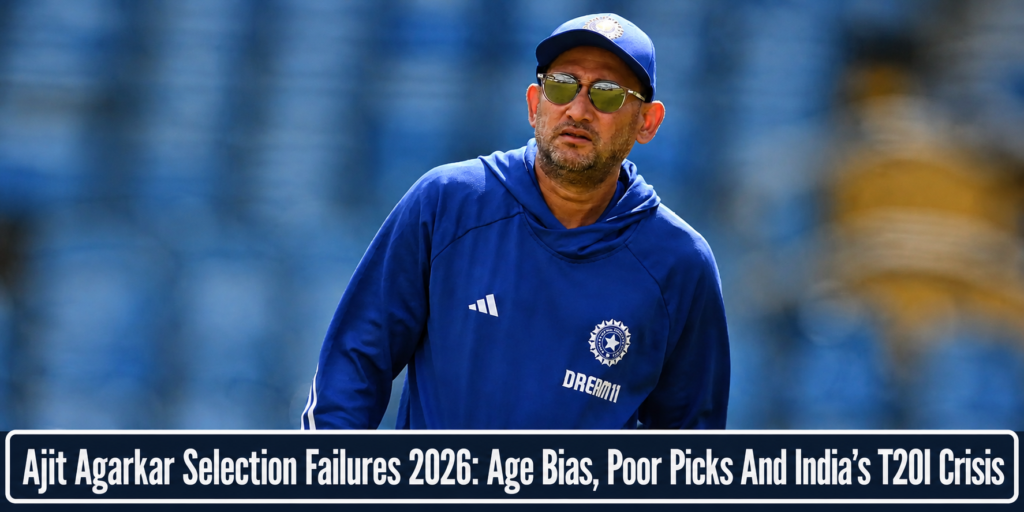
But if you zoom out from Samson’s case and look at the full picture of selection calls made under Ajit Agarkar’s watch, a larger and more troubling pattern emerges. The same players keep getting picked regardless of returns.
The players actually performing get ignored if their birth certificate has the wrong year on it.
And the players who could provide balance, power, and finishing ability are warming the benches while the team loses five consecutive T20Is for the first time in their history.
The Sanju Samson Case: Where It Started
Before moving to the broader picture, the Samson situation needs to be on the table, because it set the tone for everything that followed.
- Samson scored 321 runs across five innings in the 2026 T20 World Cup at an average of 80.25 and a strike rate of 199.38, becoming only the third Indian to win the Player of the Tournament award after Virat Kohli and Jasprit Bumrah
- His knockout scores: 97 not out off 50 balls against West Indies, 89 off 42 against England, 89 off 46 in the final against New Zealand
- He scored the most sixes by an Indian in a single T20 World Cup edition, 24, breaking Rohit Sharma’s record of 15
- He also hit two IPL centuries for Chennai Super Kings immediately after the tournament
Three low scores later against Ireland and England and he was dropped from the XI. Then omitted from the Zimbabwe squad entirely, with no public explanation. As Sadagoppan Ramesh said on record: “How can you drop the Player of the Tournament after three failures? The entire team failed against Ireland. Agarkar is serving his extended period as a chief selector because of the T20 World Cup win. It was Sanju who played a major role in that victory. Sanju Samson is the reason Agarkar is even a selector in this extended period now.”
Reports confirmed the decision to drop Samson was made by Agarkar and the selection panel, with Gautam Gambhir reportedly having no role in it. When the head coach and selectors are operating separately on a call this significant, the power structure is broken
Rajat Patidar: The Most Glaring Omission in Indian Cricket Right Now
Here is what Rajat Patidar did in IPL 2026: 501 runs in 14 innings at a strike rate of 192.69 with five half-centuries. He captained RCB to back-to-back IPL titles, becoming only the third captain in IPL history after MS Dhoni and Rohit Sharma to successfully defend the title. He is a right-handed batter in a lineup drowning in left-handers. He averages over 44 in T20Is in his brief international career. He is 33 years old.
And he is not in the squad.
Irfan Pathan was explicit about it: “Looking at the number of left-hand batters in the Indian T20 team right now, it’s even more of a reason for Team India to look at Rajat Patidar going forward. I really hope he gets an opportunity, especially since there is still plenty of time for Team India to experiment before the next T20 World Cup.”
The reason Patidar is not in the squad is almost certainly his age. At 33, the selectors appear to have decided he does not fit the “building for 2028” timeline. But India are not building for 2028 right now. They are losing to Ireland and England right now. Picking a 33-year-old who is batting at a strike rate of nearly 193 over players who are batting at 91 against spin would not hurt the 2028 plan. It would help the 2026 results. These are not mutually exclusive ideas.
Krunal Pandya: Better Than Axar Right Now, Still Ignored
This one is straightforward and the numbers make it uncomfortable to defend. Krunal Pandya outperformed Axar Patel in IPL 2026, taking 14 wickets from 16 games with an economy rate of 8.41. Across two seasons combined, he has picked up 31 wickets in 30 innings while scoring 335 runs in 16 innings, winning Player of the Match in the IPL 2025 final.
He is a genuine bowling all-rounder. He bowls left-arm spin with variety and economy. He bats explosively lower down. He is an IPL champion with match-winning experience in finals. He holds the unique distinction of being the only player to win Player of the Match in two separate IPL Finals.
He is also 35. So he does not exist in Agarkar’s selection universe.
Bhuvneshwar Kumar: 45 Wickets in Two IPL Seasons, Still Not Selected
Bhuvneshwar Kumar took 45 wickets across the last two IPL seasons and was a central reason behind RCB winning back-to-back titles. Despite all of this, the 36-year-old has found no place in the squad. It is believed that because of his age, he was not considered for selection.
Sanjay Manjrekar said: “I am very surprised about Bhuvneshwar. The way he bowled in the IPL was terrific. I don’t know whether selectors even had a chat about him.”
Bhuvneshwar at his best is one of the finest T20 bowlers India has ever produced. He swings the new ball, hits good lengths, and has the variations to trouble batters on seaming tracks, exactly the conditions India are currently falling apart in. But he is 36. So he gets nothing.
Compare this to what India sent to England: Prasidh Krishna, economy rate of 11.5 in T20Is, going at 14.25 in Belfast. If age is the filter, the least the committee could do is ensure the younger players they pick actually perform better. They have not.
Rinku Singh: A Genuine Finisher, Simply Forgotten
Rinku Singh made his name as one of India’s most natural death-overs batters. In IPL 2023, his breakthrough season, he smashed five consecutive sixes in the final over when KKR needed 28 off the last five balls to win against Gujarat Titans, producing one of the most iconic finishes in IPL history. He batted at a strike rate of 149.52 that season and earned his India call-up.
In T20I cricket, he has played 35 matches, scoring 550 runs at an average of 42.30 and a strike rate of 161.76. A strike rate of 161 from a lower-order finisher is exactly what India are missing. He is 28 years old. He is not particularly old. He is not injured. He was part of the 2026 T20 World Cup winning squad.
And he is not in this team. The committee has decided that Axar Patel at a strike rate of 131 is a better finishing option than Rinku Singh at 161. That is a selection decision that requires a detailed explanation, and none has been provided.
The Age Bias: Does It Even Make Cricketing Sense?
The argument the selectors seem to be making is this: build for 2028. Pick youth. Do not invest in players who will be 37 or 38 at the next T20 World Cup. Think long-term.
It is a sensible philosophy in the abstract. It is a disastrous one applied as a blanket rule. Age in T20 cricket is not the barrier it once was.
In T20 cricket, where experience, game awareness, and the ability to read conditions and adapt mid-innings are often worth more than raw physical pace.
A 35-year-old Krunal Pandya at an economy of 8.41 is a more dangerous bowler than a 30-year-old Prasidh Krishna at 11.5.
The numbers prove it. Age does not.
The Accountability Question
Players face consequences for three bad games. Selectors face no equivalent scrutiny even when they field structurally broken lineups for five consecutive matches. Agarkar holds considerable power, and his contract extension itself was earned on the back of India’s T20 World Cup triumph, a triumph Sanju Samson was central to.
With that power must come accountability. A squad with seven left-handers, no genuine finisher, an economy rate liability in the pace attack, and a form-blind approach to the middle order did not materialise by accident.
Someone built it. Someone signed off on it.
And the scoreboard in Nottingham, 76 all out, India’s worst T20I defeat in history, reflects those choices back with painful clarity.

Lucky Raina is a complete cricket writer chasing corporate dreams by day and cricket stories by night. Once a promising Under 16 cricketer, life took him down a different pitch but the love for the game never left.