India T20I Series Loss to England 2026: Team Selection Failures That Cost Them the Series!
India came into this England T20I series as the reigning T20 World Cup champions. Within nine days of the first ball bowled, they had been humiliated twice, handed England their first ever T20I series win over India, and set unwanted records that will sting for years.
The cracks were not formed in Manchester or Nottingham.
They were baked in long before the squad even landed.
The Series Scorecards: A Catalogue of Collapses
Before getting into the why, the what needs to be stated in full, because the scorecards are simply damning:
1st T20I, Chester-le-Street (July 1): No result. Rain washed out a match in which India had posted 189 for 7 in 20 overs. A rare positive, quickly undone.
2nd T20I, Manchester (July 4): India scored 190 for 7. England chased it down in 19 overs, winning by 4 wickets with 6 balls to spare. A competitive total, still not enough.
3rd T20I, Nottingham (July 7): England posted 201 for 7 with Phil Salt making 70 off 44 balls and Sam Curran an unbeaten 41. India were bowled out for 76 in just 11.4 overs. Jofra Archer 3 for 29. Josh Tongue 4 for 28. England won by 125 runs, India’s heaviest T20I defeat in history, beating the previous record of an 80-run loss to New Zealand in Wellington in 2019. The 76 all out was also India’s second lowest T20I total ever, behind only 74 against Australia in Melbourne in 2008, and the fastest India have ever been dismissed in the format. As Shreyas Iyer himself admitted: “I think it was atrocious. I couldn’t use a better word.”
4th T20I, Bristol (July 9): India posted 158 for 7, with Iyer’s unbeaten 80 off 48 the lone highlight. Phil Salt and Harry Brook put on an unbroken 146 off 70 balls to win with 37 balls, 6.1 overs, to spare. England won by 9 wickets. Series sealed 3-0 with a match still to play. England’s fastest ever chase of a target of 150 or more.
England have now won 19 out of 22 completed T20Is since Brook took over as captain last year. This is India’s first time losing back-to-back T20I series since 2018-19. Five losses in a row. Their worst ever run in the format.
The Batting Order Makes No Sense
Look at the top eight in India’s batting order and a glaring structural problem stares back at you:
- Abhishek Sharma (Left-hand bat)
- Vaibhav Sooryavanshi (Left-hand bat)
- Ishan Kishan (Left-hand bat)
- Shreyas Iyer (Right-hand bat) — the ONLY right-hander in the top eight
- Tilak Varma (Left-hand bat) — Clueless/Helpless
- Washington Sundar (Left-hand bat) — Clueless/Helpless
- Shivam Dube (Left-hand bat) — Clueless/Helpless
- Axar Patel (Left-hand bat) — Clueless/Helpless
Seven left-handed batters and one right-hander in the top eight. This is not a batting lineup. This is a gift to any bowling captain with half a plan. England exploited it ruthlessly across three consecutive games, setting one set of fields, bowling one consistent angle, and watching India play straight into their hands over and over again.
Tilak Varma: The Last 10 Innings Tell the Real Story
Tilak Varma has been given every opportunity to cement his place in this side. The selectors have backed him through a lean run, made him vice-captain, and kept him in the XI regardless of returns. But the numbers across his recent innings paint a picture that loyalty alone cannot paper over.
Across his last eight innings at various levels, Tilak’s scores read 3, 24 not out, 13, 55, 19, 67, 59 and 23 not out, with the latter three knocks for India A also coming at a tempo that left room for improvement. His inability to consistently accelerate has become a recurring theme.
Against England in this series, he contributed 13 in Manchester and was caught off a slower-ball bouncer in Bristol before making any real impact. In 2026 T20Is, he has scored 90 runs from 98 balls against spinners, getting dismissed four times, at an average of 22.5 and a strike rate of just 91.8, numbers far below the standard expected from a specialist middle-order batter.
A strike rate under 100 against spin from a number five batter in T20I cricket is not a dip in form. It is a structural problem. Opposing teams have identified it, targeted it consistently, and Tilak has not yet found an answer.
Axar Patel With the Bat: Nowhere Near a Finisher
Axar Patel is a very fine cricketer. His left-arm spin has value, and his bowling has earned him 100 international T20 wickets. But the idea of Axar Patel as a genuine T20I finisher, a role India are trying to fill in the absence of Hardik Pandya, does not hold up to scrutiny.
In his T20I career, Axar bats at six or seven and averages in the mid-twenties in the format. His batting strike rate across his T20I career is respectable in domestic cricket and for a bowling all-rounder, but it is nowhere near the 160-plus that a designated death-overs finisher needs to carry in international T20 cricket. His status as a big-match player was cemented by his 47 in the 2024 T20 World Cup final against South Africa, and that remains his standout batting performance on the global stage. One explosive cameo in a World Cup final two years ago is the evidence supporting his finisher credentials. That is a thin file for the role India need filling.
In this England series, Axar was run out off the last ball of the Bristol innings having managed 14 off 18 deliveries, contributing nothing to the acceleration India desperately needed. There is no MS Dhoni here. There is no Kieron Pollard. There is no Harry Brook. India are going into the final overs of T20Is without someone whose presence at the crease genuinely frightens the opposition, and that gap has cost them repeatedly.
Prasidh Krishna Is No Glenn McGrath
Prasidh Krishna arrived in Ireland on the back of strong IPL form, having taken 16 wickets in 12 matches for Gujarat Titans in IPL 2026 and 25 the season before. On flat IPL tracks, he is a threat. In international T20I cricket overseas, the numbers tell a very different story.
As Aakash Chopra pointed out on his YouTube channel: “Prasidh has played six games for India in T20Is so far. He is a wicket-taking bowler, but look at his economy rate, which is 11.5 runs per over. He has conceded 277 runs from his 24 overs. To concede so many runs is way too expensive.”
In the first Ireland T20I alone, he leaked 57 runs in 4 overs without taking a single wicket, at an economy rate of 14.25. In one over, Ireland’s Gareth Delany smashed him for three consecutive sixes, 27 runs from a single over, which became the most expensive over bowled by an Indian against Ireland in T20I cricket. He also conceded 125 runs across his last two T20I appearances, the most by any bowler in successive T20Is.
Glenn McGrath could hit a seam-up length all day and ask questions constantly. Prasidh Krishna, on seaming English surfaces where conditions are actually supposed to favour him, went for more runs than India’s batters scored in their worst innings. An economy rate of 11.5 in T20I cricket is not a pace bowler being unlucky. It is a pace bowler who does not have the variations or the game awareness to consistently tie down international batters on good batting surfaces. India carried him across the entire UK tour and it cost them overs and momentum in both games.
No Finisher, No Balance, No Plan B
If there is one position that defines India’s structural problem in this series, it is the death-overs batting slot. England have Harry Brook. India have a rotating cast of candidates who cannot finish games.
Shivam Dube was supposed to be the power-hitter. He fell to a mid-on catch off spin in Bristol before making any impression. Washington Sundar, who is primarily a bowling all-rounder, has been pushed into batting positions that are above his reliable range. Axar, as discussed, is not a finisher by the numbers. Harshit Rana and Prince Yadav, genuine pacers, were occasionally contributing cameos at the death because nobody else could. That is not a batting lineup. That is a bowling attack with a tail that starts at number six.
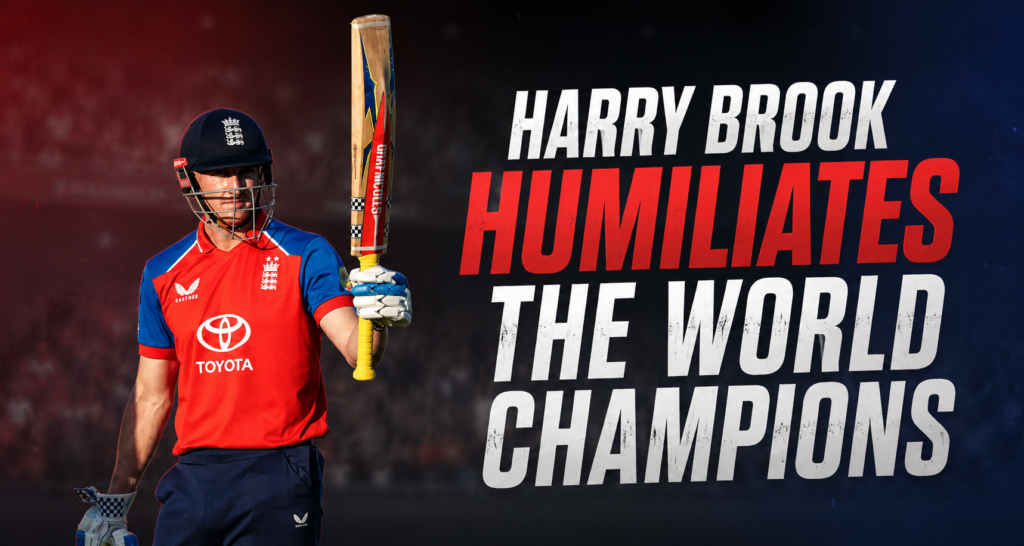
Harry Brook: A Different Breed Entirely
While India’s batters found excuses in pitches and conditions, Harry Brook looked at the same surfaces and turned them into his personal highlight reel. Let that comparison sink in.
In Bristol, England chased down India’s 159-run target inside 14 overs. Harry Brook made an unbeaten 79 off just 35 balls. This was on a pitch that India’s own batters described as two-paced and difficult, where slower-ball bouncers were catching top edges all evening. Brook danced down to Adil Rashid and hit him back over his head for six. He scooped Arshdeep Singh from outside off stump for six with the ball cramping him for room. He backed away and punched over long-on off the back foot in a shot that Cricinfo described as “almost Kohli vs Rauf at the MCG.”
View this post on Instagram
Brook’s Player of the Match comment said it all: “It felt good. Just those conversations with the coaches about the best ways to hit on this ground. Thankfully I got a few out of the middle.” No panic. No excuses about the pitch. Conversations with coaches, clarity of plan, and 79 off 35 balls. That is what a match-winner looks like.
The Bristol pitch is not a mystery. The average score in the seven T20Is at the County Ground is 186, and the highest chase at the venue was 199, which India themselves achieved against England in 2018. England did not make the pitch look easy. Brook made the pitch look easy while that pitch was simultaneously making India’s batters look helpless. That gap between the two sides in this series has been not just technical but mental, and Brook has been the clearest illustration of it.
Brook and Salt put on an unbroken 146 off 70 balls on a pitch where India’s best batter, Iyer, was fighting alone and scoring 44 of the 49 runs that Adil Rashid conceded just to give the total some respectability. Brook and Salt barely broke a sweat chasing the same target.
Dropping Sanju Samson Is the Biggest Mistake of All
This is the selection call that no amount of squad management language can defend.
Sanju Samson became only the third Indian to win the T20 World Cup Player of the Tournament award, after Virat Kohli and Jasprit Bumrah. He scored 321 runs across five innings at an average of 80.25 and a strike rate of 199.38. His knockout scores: 97 not out off 50 balls in the Super 8 against West Indies. 89 off 42 in the semi-final against England. 89 off 46 in the final against New Zealand.
Three low scores later, he was out of the XI. Then left out of the Zimbabwe squad entirely. India went into this England series without a genuine number three, without a player who can anchor an innings under pressure in seaming conditions, without the man who three months ago was the best batter at the biggest tournament on earth.
The irony is sharp. In the same series where England handed Brook the freedom to bat without constraint and he responded with game-defining performances, India left their World Cup Player of the Tournament at home. Harry Brook was given a stage. Sanju Samson was not even given a ticket to the ground.
The System Is the Problem, Not Just the Selection
India’s T20I losses now stand at five in a row, their worst ever losing run in the format. They lost a bilateral series to Ireland for the first time in history. They have now conceded to England their first ever T20I series win over India. For a side that went 16 consecutive T20I series unbeaten after winning the 2024 World Cup, this level of collapse in the space of three weeks is extraordinary.
England did not need anything extraordinary. They bowled a consistent seaming length. They set logical fields for a lineup with seven left-handers. They let Tongue and Archer do their work and watched India do the rest. That is the most devastating verdict of all: England were not brilliant. India were broken. And the blueprint for that broken team was drawn up in a selection meeting, not on a cricket pitch.

Lucky Raina is a complete cricket writer chasing corporate dreams by day and cricket stories by night. Once a promising Under 16 cricketer, life took him down a different pitch but the love for the game never left.