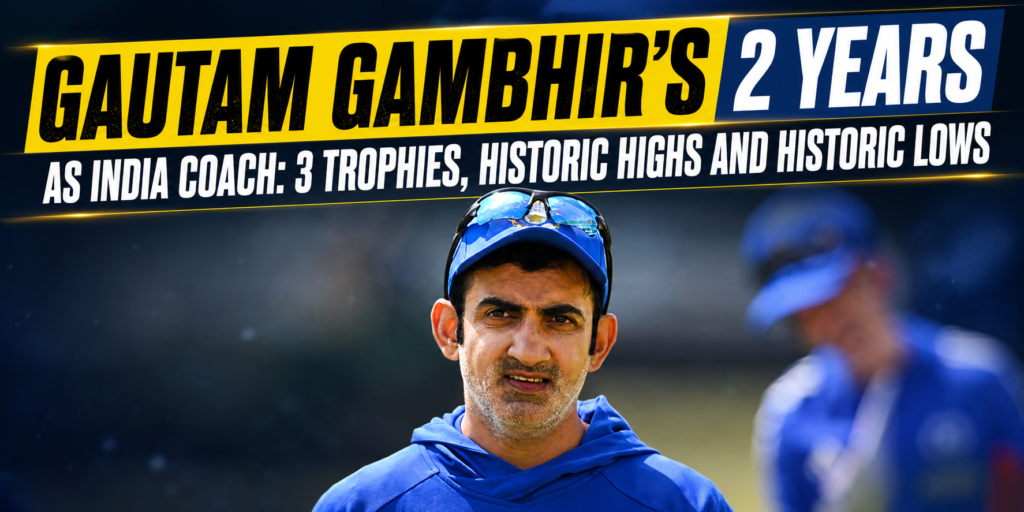
Gautam Gambhir was appointed India’s head coach on 9 July 2024, walking into one of the most demanding jobs in world sport.
Two years on, almost to the day, India are 3-0 down to England in a T20I series, their World Cup Player of the Tournament has been dropped, and the question of his legacy is being asked more loudly than at any other point in his tenure.
The honest answer to that question is genuinely complicated, because the highs under Gambhir have been historic, and so have the lows.
The Trophies: A Record No Other Indian Coach Has Matched
Start here, because the achievements are real and they are significant:
1. ICC Champions Trophy 2025: India beat New Zealand in the final in Dubai, ending a 12-year wait for the title. It was India’s third Champions Trophy.
2. Asia Cup 2025: India defeated Pakistan in the final, adding a sixth Asia Cup title.
3. ICC Men’s T20 World Cup 2026: India beat New Zealand by 96 runs in Ahmedabad, becoming the first team ever to defend the T20 World Cup title, the first to win it on home soil, and the first to claim three T20 World Cup titles.
Gambhir became the first Indian head coach to win two major ICC titles, guiding India to the Champions Trophy 2025 and the T20 World Cup 2026. He is also the first person in the history of the game to win a Men’s T20 World Cup as both player (2007) and coach (2026).
Three ICC tournaments. Three trophies. No finals lost.
That record alone places him among the most decorated coaches in Indian cricket history.
The Unwanted Records: A List That Keeps Growing
But alongside those three trophies, Gambhir’s tenure has accumulated a set of unwanted records that are simply too significant to be explained away as background noise or bad luck:
In Tests:
- India lost a home Test to New Zealand for the first time in 36 years, before suffering their first-ever home Test series defeat to the Black Caps, a 3-0 whitewash that marked India’s first-ever clean sweep in a home Test series
- A year later, India suffered another home Test series defeat to South Africa, losing a home Test against the Proteas after 15 years and a home series after 25 years
- India failed to qualify for the World Test Championship final for the first time
- India lost the Border-Gavaskar Trophy for the first time in 10 years
In white-ball:
- India lost a bilateral ODI series to Sri Lanka for the first time in 27 years. They also remained winless in a calendar year in ODIs for the first time in 45 years
- India lost to Ireland in T20Is for the first time in history, ending a 16-series unbeaten streak
- India have now lost five straight T20Is for the first time in their history
- India suffered their heaviest T20I defeat ever, losing by 125 runs in Nottingham after being bowled out for 76
The point is not that these records cancel out the trophies.
The point is that both sets of facts exist simultaneously in the same two-year tenure, and a balanced assessment has to hold both.
The Explanation: Partly Valid, Partly Not
Gambhir’s position is that the white-ball results reflect a high-risk, high-reward philosophy that will produce bad days alongside the great ones. He said: “I would rather accept that we get all out at 100, but 150-160 takes you nowhere. If you play high risk, that’s when you make 250 or 260 runs. There will be days when you get 100. But if you play that kind of cricket, that’s when you give yourself the best chance.”
That philosophy produced a T20 World Cup final where India scored 255 in 20 overs. It also produced a 76 all out in Nottingham. The philosophy is internally consistent, but whether its application in Ireland and England was right given the conditions available is a separate question.
On the Test failures, the explanation of transition and a rebuilding squad carries less water. Two home series defeats in successive years, against New Zealand and South Africa, while also losing the Border-Gavaskar Trophy in Australia, is a pattern in red-ball cricket that goes beyond personnel transitions. India’s Test batting, outside of Virat Kohli and Rohit Sharma’s peak years, has been found out repeatedly by quality seam bowling overseas, and that structural issue has not been addressed.
The Gambhir Paradox
Perhaps the most interesting thing about Gambhir’s two-year tenure is how cleanly it splits across formats. His white-ball record at ICC events is perfect. Three tournaments, three trophies, zero finals lost. His Test coaching record is among the most difficult of any modern India coach to defend.
It creates a genuine paradox. The same man, the same coaching staff, the same philosophy, producing polar-opposite results depending on the format. That is not typical. Usually a coaching staff either works across the board or struggles across the board. Gambhir is almost uniquely good in one format and troubling in another simultaneously.
Where This Leaves Him
Gambhir’s contract runs until the 2027 ODI World Cup. If he wins that trophy, which would be India’s third 50-over World Cup and the culmination of one of the most decorated coaching careers in the history of Indian cricket, history will be kind to him. If India continue to slide in T20Is and lose ground in Tests, the current run of results in England will be remembered as the moment when the post-World Cup glow wore off and the real questions began.
Right now, two years in, the honest verdict is this: he is the most successful ICC-event coach India has ever had, and the holder of more unwanted records than any coach should be comfortable with. Both of those things are true at the same time. That is the complexity of the Gambhir era, and it deserves to be understood in full, not reduced to either pure celebration or pure criticism.
The next 12 months will go a long way toward writing the final verdict.

Lucky Raina is a complete cricket writer chasing corporate dreams by day and cricket stories by night. Once a promising Under 16 cricketer, life took him down a different pitch but the love for the game never left.