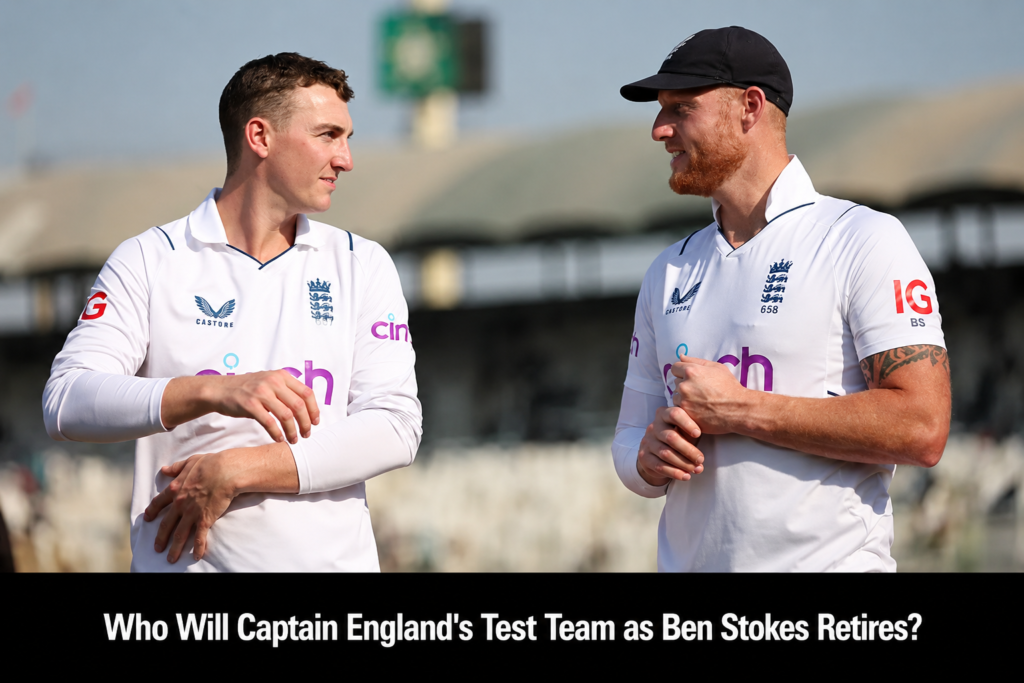
Ben Stokes walked off the field at Trent Bridge on 28 June 2026 to a standing ovation, and the moment his career ended, a question immediately took its place: who leads England now?
It sounds simple. It is anything but. The England Test captaincy is one of the most demanding leadership roles in sport. Stokes held it for four years, won it with an almost evangelical ferocity, and left it with a record that only Mike Brearley has bettered in terms of win percentage. The man who takes it next does so knowing that the bar has been set not just high but practically in the clouds.
There is no obvious heir. There is no ready-made successor waiting in the wings with a file full of captaincy experience and a dressing room already eating out of his hand.
Harry Brook: The Vice-Captain With Everything to Prove
On paper, Harry Brook is the next England Test captain. He is the current vice-captain, he already holds the ODI and T20I captaincy, and at 27 years old he is the ICC’s number one ranked Test batsman with a staggering average of 53.9 from 37 Tests. He scored England’s first Test triple century in 34 years, hitting 317 against Pakistan in 2024. He broke the world record for the fastest player to reach 3,000 Test runs in terms of balls faced. By any batting measure, he is already a superstar.
But the path to the Test captaincy right now is not straightforward for Brook, and the ECB knows it. The same midnight curfew that Stokes breached ahead of the Oval Test this summer was originally put in place because of Brook’s own incident during England’s winter tour of New Zealand. To hand Brook the Test captaincy immediately after that context would put both him and the ECB in an awkward position that no one is pretending does not exist.
Rob Key, the ECB managing director, has publicly said Brook has more learning to do before the role is formally his. That is not a dismissal. It is a timeline. The long-term plan almost certainly has Brook at the centre of it. The question is whether he gets the job now or whether a bridge is needed first.
- The case for Brook: He is England’s best batsman. He has already shown he can lead, captaining England to a T20I whitewash of West Indies and delivering authority in the ODI role. His hunger is obvious. His talent is beyond question.
- The complication: The optics of handing him the Test captaincy at this precise moment, given the curfew context, are difficult. The ECB may judge that a short-term interim appointment protects both Brook and the role itself.
- Verdict: The long-term captain. Whether he gets the job immediately or after an interim period is the only real question.
Joe Root: The Safe Pair of Hands England May Need Right Now
Joe Root has been here before. He captained England in 65 Tests between 2017 and 2022, winning 28 of them, and holds the record for most wins as England Test captain outright. He stepped down after the 2021-22 Ashes whitewash in Australia, emotionally drained and ready to hand the baton to Stokes. He has since flourished without the captaincy burden, averaging 57 from 35 Tests as a free-spirited batsman and moving to second on the all-time Test run-scorers list behind only Sachin Tendulkar.
Root has already stepped in as interim captain this summer at The Oval when Stokes was stood down for the second Test. He is the most experienced leader available, the most respected senior voice in the dressing room, and a player whose batting goes up not down when he does not have the captaincy sitting on his shoulders.
The argument against Root is that England already tried this chapter. He gave four and a half years of leadership, it ended in a 4-0 Ashes defeat, and stepping backwards carries the risk of looking like a holding pattern rather than a plan. Root himself has not ruled it out, and the ECB has shown they are willing to lean on him in moments of need.
- The case for Root: Experience, authority, respect, and a batting average that tells you the captaincy burden will not eat him alive. He has done this at the highest level for years.
- The complication: Going back to a former captain is rarely a rallying cry. At 35, Root’s career as a player has a natural horizon, which limits how long any captaincy stint would realistically last.
- Verdict: The most likely interim solution while Brook matures into the permanent role. A steady pair of hands at a turbulent moment, and there is nothing wrong with that.
Jacob Bethell: The Wildcard Who Is Ahead of Schedule
Jacob Bethell is 22 years old and already carries the distinction of being the youngest player ever to captain England, having led the T20I side against Ireland in August 2025. That is not an honorary title. McCullum and Key handed it to him deliberately, knowing full well who they were putting in charge. The ECB does not make that call without believing, sincerely, in the player’s leadership instincts.
Born in Barbados and raised in England, Bethell is a left-handed batsman and right-arm seamer who has already made a Test century, scoring 154 in the fifth Ashes Test at Sydney in January 2026. He scored 105 off 48 balls against India in the semi-final of the 2026 T20 World Cup. He is, in the truest sense, ahead of schedule as a cricketer, and the whispers around the ECB suggest he is also ahead of schedule as a leader.
The risk is real. Giving a 22-year-old the Test captaincy before he has accumulated the Test experience to back it up could place an enormous weight on a player still finding his feet in the longest format. Bethell has only played a handful of Test matches. The captaincy at this level requires not just talent but the kind of calm authority that usually comes from having navigated hard situations as a player first.
The case for Bethell: Already captained England. Already scored at the highest level. Already trusted by the ECB. The youngest member of an exciting generation and the potential future of English cricket for a decade.
The complication: Test cricket is a different world from T20Is. The experience gap is significant, and loading a 22-year-old with the Test captaincy before he has truly established himself in the format is a gamble that could hurt both the team and the player.
Verdict: A genuine future captain, potentially the one who leads England into the 2030s. But not yet. Not immediately.
The Wider Picture: What Kind of Captain Does England Need?
Before settling on a name, England’s selectors need to decide what kind of captain this team needs right now. That is a more important question than any individual’s credentials.
Stokes led from the front with bat, ball, and force of personality. He was the team’s best player and its leader simultaneously. That combination is vanishingly rare, and chasing it as a template for his successor is a fool’s errand. The next captain does not need to be the best player in the side. Some of the greatest Test captains in history were not the most gifted cricketers in their team. What they had was clarity of thinking, the ability to read a game, the trust of the dressing room, and the composure to make decisions under pressure without second-guessing themselves.
England also need to decide how much continuity they want with the Bazball philosophy. If they want to keep the attacking, fearless brand of Test cricket alive in some form, the captain needs to embody it. Brook does naturally. Root did not build his career on those terms, though he has adapted well within the system. Bethell is the purest product of the Bazball generation.
The Honest Assessment
There is no Ben Stokes waiting in the ranks. There never was, and there never will be, because players of his kind come along once in a lifetime. The question is not who can replace him but who can lead well enough that England find a new identity in the years ahead.
The most logical sequence, reading everything available today, looks something like this: Root takes the captaincy on an interim basis for the remainder of the 2026 summer and possibly into the winter tour. That buys Brook time, space, and the chance to re-establish himself as the undisputed next man up. When the moment is right, Brook takes the job on a long-term basis and becomes the face of English Test cricket into the next decade.
Bethell sits in the background, developing rapidly, captaining in white-ball formats, and accumulating the Test experience that will eventually make him the most natural long-term successor of the three.
It is not as clean or as exciting as handing the job to a single obvious heir. But English cricket rarely does things the clean way, and the candidates in front of them, complicated as they are, are genuinely talented. The next chapter will not look like the Stokes era. That is not a failure. That is simply what comes next.
The torchbearer will step forward. English cricket always finds one.

Lucky Raina is a complete cricket writer chasing corporate dreams by day and cricket stories by night. Once a promising Under 16 cricketer, life took him down a different pitch but the love for the game never left.