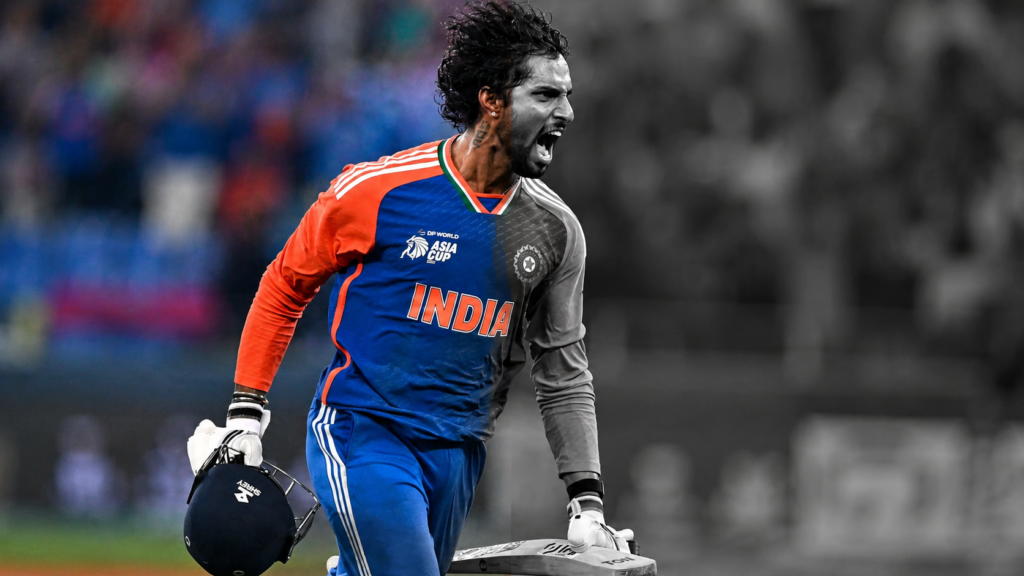
Every time Tilak Verma gets out, I notice two completely different reactions. One section of fans calls him India’s next crisis man. The other immediately asks for more patience because he is still young.
Personally, I think both extremes miss the bigger picture.
My question is much simpler: How many pressure performances does a player need before being called clutch, and how many failures should be ignored before that label starts looking premature?
The Numbers Raise More Questions Than Answers
| Opponent | Runs Scored | Balls Faced | Strike Rate |
|---|---|---|---|
| England | 13 | 13 | 100.00 |
| Ireland | 55 | 46 | 119.57 |
| Ireland | 19 | 21 | 90.48 |
| New Zealand | 8 | 6 | 133.33 |
| England | 21 | 10 | 210.00 |
| West Indies | 27 | 15 | 180.00 |
| Zimbabwe | 44 | 16 | 275.00 |
| South Africa | 1 | 2 | 50.00 |
| Netherlands | 31 | 27 | 114.81 |
| Pakistan | 25 | 24 | 104.20 |
| Total | 244 | 181 | 134.81 |
Looking at this table, one thing immediately stands out to me. The headline numbers may appear respectable at first glance, but the context tells a different story. Apart from the explosive 44 against Zimbabwe and the quick 21 against England, most innings were played at a strike rate that falls below what I expect from a modern No. 4 or No. 5 T20 batter.
What concerns me even more is the absence of a defining knock against a top-quality attack in a high-pressure game. There are starts, there are useful contributions, but I don’t see enough innings that completely shifted momentum in India’s favour.
If we’re going to call someone a clutch player, then the standard has to be much higher than scoring 20s and 30s. Clutch players win matches when the pressure is at its peak. Right now, I believe Tilak Verma is still trying to prove he belongs in that category rather than having already earned it.
However, where are the innings that completely changed the outcome of a high-pressure international match?
IPL Reputation Shouldn’t Decide International Reputation
I understand why Tilak receives so much praise. His IPL record has been impressive, and he has produced several rescue acts for Mumbai Indians.
However, I don’t believe IPL performances alone should decide who gets labelled a clutch player for India. International cricket demands something different.
- The pressure is higher.
- The margin for error is smaller.
And the opposition exposes technical weaknesses much faster.
Until those IPL performances translate consistently into international pressure games, I find it difficult to hand out labels like “crisis man” or “clutch finisher.”
One Knock Doesn’t Create a Clutch Reputation
Whenever this discussion comes up, someone immediately points to one brilliant innings. I don’t disagree that Tilak has played excellent knocks.
The problem is consistency.
- A clutch player isn’t remembered because of one memorable fifty.
- A clutch player builds a reputation by repeatedly delivering when the team is under pressure.
That’s exactly what made players like Hardik Pandya earn that reputation over time.
I haven’t seen enough of that consistency from Tilak in India’s colours yet.
The Strike Rate Is Another Talking Point
Another aspect I keep coming back to is his scoring rate. Across these last ten T20I innings, Tilak has scored at a strike rate of 134.81.
That isn’t poor in isolation. However, context matters.
Modern T20 cricket expects middle-order batters to accelerate against older balls, attack spin, and finish innings aggressively. Too many innings in this sample ended with strike rates around or below a run a ball.
Those innings helped occupy the crease, but I struggle to view them as innings that seized control of a T20 match.
Are We Judging Potential Instead of Performances?
This is the question I keep asking myself. Am I watching a proven clutch player?
Or am I watching a talented young batter who is being projected into that role before consistently earning it?
There’s nothing wrong with backing potential. There is something wrong with confusing potential with proven match-winning ability.
Those are two very different things.
Final Thoughts
I still believe Tilak Verma has the talent to become one of India’s best middle-order batters.
However, based on what I have seen in recent T20 internationals, I don’t think the “clutch player” tag has been fully earned yet.
The numbers suggest a player who is still searching for consistency in pressure situations rather than someone who has already mastered them.
For me, the debate isn’t whether Tilak deserves opportunities.
It’s whether Indian cricket has started celebrating the reputation before the performances have consistently caught up.

Lucky Raina is a complete cricket writer chasing corporate dreams by day and cricket stories by night. Once a promising Under 16 cricketer, life took him down a different pitch but the love for the game never left.