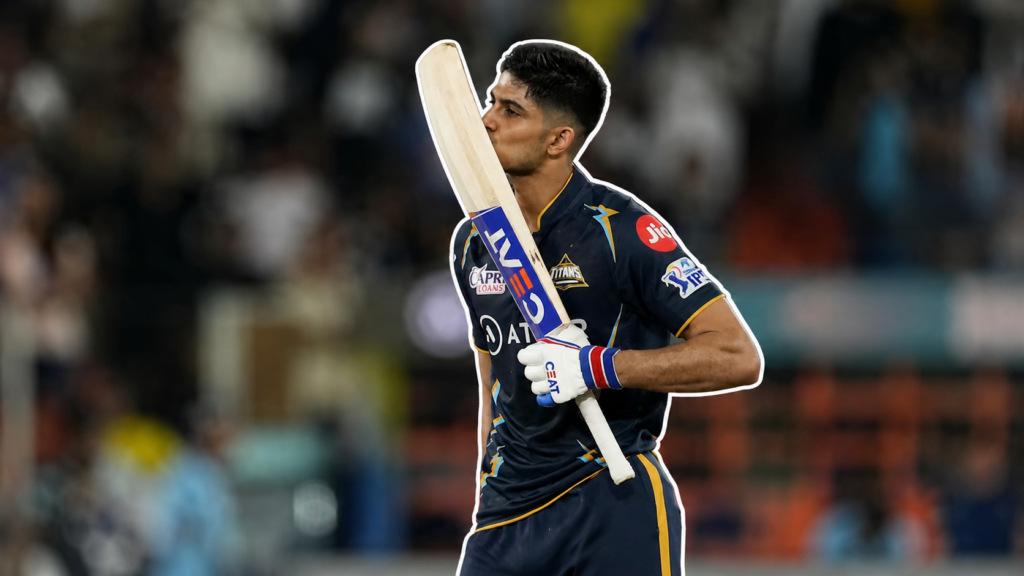
Think Shubman Gill is a big-match winner? Is Shubman Gill Actually Clutch?
The Indian Premier League (IPL) playoffs are where reputations are forged and “superstar” status is truly tested. For a long time, a narrative has been carefully constructed around Gujarat Titans captain Shubman Gill, framing him as the heir apparent to India’s batting throne with flawless big-match DNA.
Look at the surface-level charts for IPL playoff records batting, and you will see Gill’s name sitting near the top. But surface numbers hide deep tactical flaws. When you peel back the layers of the Shubman Gill IPL playoffs record, an uncomfortable question emerges: Is Shubman Gill actually a big-match player, or is his legacy built on statistical inflation?
Shubman Gill IPL Playoffs Record: 47.50 Average is a Lie
To understand the critique, we must look at the raw data that Gill’s defenders use. In 11 IPL playoff innings up to the 2026 season, Gill has amassed 475 runs at an average of 47.50. On paper, that is elite. It places him third on the all-time run-scorers list in IPL playoff history, trailing only legends Suresh Raina and MS Dhoni.
However, an average in T20 cricket is notoriously misleading, especially when skewed by a single historic day out.
Shubman Gill IPL Playoff Record (Overview)
- Total Innings: 11
- Total Runs: 475
The Outlier (vs MI, 2023): 129 (27% of all playoff runs)?
Remaining 10 Innings Average: 34.60
Gill Fails in Big IPL Knockout Matches? Nearly 27% of Gill’s entire playoff runs came in a single evening: his breathtaking highest individual score in IPL playoffs (129 off 60 balls) against the Mumbai Indians in Qualifier 2 of the 2023 season. Take away that single anomaly at his absolute favorite hunting ground in Ahmedabad, and his playoff average plummets to a pedestrian 34.60
A true big-match player delivers consistent, heavy impact across multiple high-pressure games. For Gill, the reality is a story of one massive peak surrounded by relative mediocrity.
His structural approach to the T20 format?
The core issue with Gill in knockout matches is his structural approach to the T20 format. Modern T20 cricket demands high-intent, high-impact scoring from ball one, particularly in the Powerplay when only two fielders are outside the circle.
In low-stakes league matches, Gill’s anchor template works fine. But in high-pressure games, his lack of early boundary-release options becomes a massive liability. Advanced cricket metrics highlight a glaring flaw in his approach:
-
The Dot-Ball Pressure: In high-stakes matches, Gill’s Powerplay dot-ball percentage frequently hovers near 36%.
-
The Stagnation Effect: By consuming valuable balls early without finding boundaries, he puts immense scoreboard pressure on his opening partner and the middle order.
-
The High-Risk Catch-Up: When he fails to accelerate after anchoring, he gets dismissed for a slow 20 or 30, leaving the team completely stranded.
We saw this exact vulnerability during his early years with the Kolkata Knight Riders (KKR) during their 2021 playoff run, and it has occasionally followed him to the Gujarat Titans playoff stats. When opposing bowling units tighten their lines and execute disciplined defensive lengths, Gill’s inability to manufacture unorthodox shots stalls the entire team’s momentum.
The Ahmedabad Factor: Home Comforts vs. True Knockouts
Another major critique of Gill’s big-match credentials is his stark reliance on venue assistance. Gill’s modern legacy is heavily tied to the Narendra Modi Stadium in Ahmedabad—a ground known for its true bounce, lightning-fast outfields, and favorable batting conditions under lights.
When playing at neutral venues or on turning tracks where cross-bat shots are risky, his efficiency drastically drops. A breakdown of his defining playoff knocks shows a worrying trend:
| Key Playoff Match | Venue Type | Batting Performance | Tactical Impact |
| 2023 Qualifier 2 (vs MI) | Flat/Fast (Ahmedabad) | 129 (60) | Match-winning masterpiece |
| 2022 Final (vs RR) | Flat/Fast (Ahmedabad) | 45* (43) | Subdued anchor role, low chase |
| 2021 Final (vs CSK) | Sluggish (Dubai) | 51 (43) | Too slow in a massive 193-run chase |
When chasing 193 against CSK in the 2021 Final, Gill’s 51 off 43 balls lacked the necessary intent, effectively batting KKR out of the chase. A strike rate of 118.60 in a high-scoring final is not “big match DNA”—it is a failure to read the match situation.
Shubman Gill vs Virat Kohli: Who is the Real Clutch Player?
The Statistical Reality: While Virat Kohli has historically carried his team under pressure with multiple high-stakes fifties across T20 World Cups and IPL knockouts, Gill’s reliance on a single batting venue exposes a major gap between the “King” and the “Prince.”
The Final Verdict: Can GT Trust Gill in a Must-Win IPL Final?
Shubman Gill is an extraordinary cricket player with pristine orthodox technique and superb statistical accumulation. But calling him a clutch knockout specialist is a stretch of the imagination.
His Shubman Gill IPL playoffs record is heavily padded by a few massive nights on a flat home deck. When the pitch offers assistance to bowlers or the match situation demands immediate, selfless aggression, the “Prince” often retreats into his shell. For a critical analyst, the data is clear: Gill has the tools to be a great accumulator, but until he fixes his Powerplay bottleneck, his big-match DNA remains a myth.

Lucky Raina is a complete cricket writer chasing corporate dreams by day and cricket stories by night. Once a promising Under 16 cricketer, life took him down a different pitch but the love for the game never left.