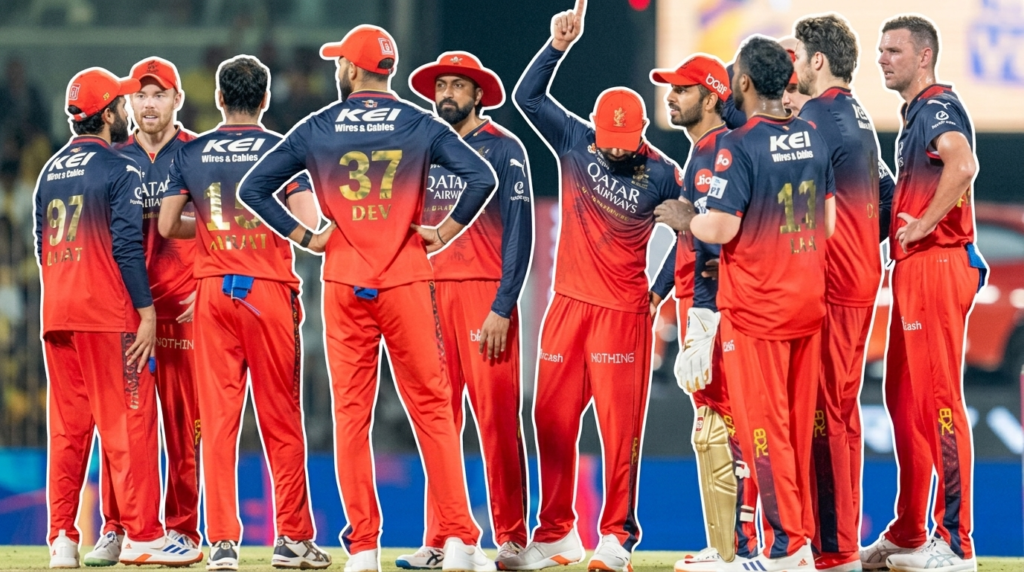
Eighteen years of hurt ended in Ahmedabad on June 4, 2025. Royal Challengers Bengaluru finally lifted the IPL trophy, beating Punjab Kings by six runs in the final, with Virat Kohli’s 657-run campaign and Josh Hazlewood’s 22 wickets at the heart of it.
The question that has followed the defending champions into IPL 2026 is a simple but loaded one: is this version of RCB better than the one that won, or is the title defence already showing the cracks that come with the unique pressure of protecting what you have finally earned?
Where RCB Stand in IPL 2026: Second on the Points Table
Royal Challengers Bengaluru are second on the IPL 2026 points table with 12 points from nine matches, sitting just behind unbeaten Punjab Kings. On the surface, those numbers tell a story of a team doing well. But the path to those 12 points has not always looked like a title-winning team’s performance.
RCB have had dominant days and vulnerable ones, and the balance between those two versions of themselves will determine whether they can become only the second franchise in IPL history to win back-to-back titles after CSK in 2010 and 2011.
What RCB Have Done Better in IPL 2026 Than in 2025
The most striking improvement in IPL 2026 has come from Virat Kohli’s batting approach. In IPL 2025, Kohli scored 657 runs at a strike rate of 144.71 across 15 matches with 8 fifties. In IPL 2026, his strike rate has risen to 163.18, his best in any IPL season, and he is already among the top run-scorers through nine matches. He has also crossed the 9,000-run mark in the IPL during this season, becoming the only player in the history of the league to reach that landmark.
Devdutt Padikkal has also elevated his game significantly in 2026. After two difficult mid-career seasons elsewhere, he returned to RCB for IPL 2025 and carried that momentum into 2026, scoring at a strike rate above 150 and playing the kind of aggressive number three innings that RCB could not consistently find in previous seasons.
In the match against DC on April 27, RCB bowled DC out for 75, the lowest total of IPL 2026, then chased it down in 6.3 overs. RCB’s NRR improved from 1.101 to 1.919 in a single game. That kind of comprehensive, utterly dominant performance did not happen often enough in the 2025 season, where RCB won tightly and nervously more often than comfortably.
Bhuvneshwar Kumar became the first pace bowler in IPL history to take 200 wickets during RCB’s 2026 campaign, a landmark that arrived during the win over CSK in early April and which underlines how central he has been to both the 2025 title run and this season’s bowling attack.
What RCB Have Done Worse in IPL 2026 Than in 2025
The single biggest issue RCB have faced in 2026 is the Phil Salt problem. In IPL 2025, Salt’s powerplay aggression and his opening partnership with Kohli were foundational to how RCB set their innings up. Salt posted a strike rate of 175.98 in 13 matches during that title-winning campaign. In IPL 2026, Salt has missed consecutive matches due to injury, forcing RCB to repeatedly reshuffle their opening combination at a time when every powerplay over is critical.
The bowling attack has also been inconsistent in a way it was not in 2025. Hazlewood missed the first two matches of IPL 2026 with hamstring and Achilles injuries, and during those early games without him, RCB’s bowling looked noticeably thinner. Bhuvneshwar at 36 and carrying a history of fitness issues is not guaranteed to bowl four full overs in every match.
Venkatesh Iyer was the marquee addition to the squad, signed for Rs 7 crore to solve the number three problem. But his integration into the batting order has not been entirely smooth, and the balance between him and Padikkal for the same slot has required ongoing management from Patidar and the coaching staff.
The Defending Champion Burden: Why History Makes This Hard
Only CSK have successfully defended an IPL title in the tournament’s 19-year history, winning back-to-back in 2010 and 2011. Every other defending champion has failed to repeat. The reasons are well understood: opposition teams study the champions with unusual intensity, the psychological shift from chasing history to defending it is significant, and the hunger that drives a team in a title-winning season is structurally different from the hunger needed to defend.
RCB are aware of this. The squad continuity, with 17 of 25 players retained from the title-winning group, was a deliberate choice to preserve chemistry and clarity of roles. The champions’ belief that comes from a shared experience of winning together is something no auction or strategy session can manufacture, and RCB have it in a way they have never had before.
Verdict: Better in Attack, More Vulnerable in Depth
The honest answer to whether RCB are better or worse in IPL 2026 is: better individually, more fragile structurally. Kohli is batting better. Padikkal is contributing more consistently. The bowling, when Hazlewood and Bhuvneshwar are both fit and firing together, is genuinely elite. The nine-wicket win over DC is evidence of what this team can do at its best.
But the Salt injury, the depth concerns behind Hazlewood, and the challenge of managing an older bowling group across a full 14-match league stage plus playoffs create a structural fragility that the 2025 version of RCB did not have to manage quite so carefully. Second place on the IPL 2026 points table is a strong position to be in. Whether they can sustain it all the way to a back-to-back title, only the final stages of this extraordinary season will reveal.

Lucky Raina is a complete cricket writer chasing corporate dreams by day and cricket stories by night. Once a promising Under 16 cricketer, life took him down a different pitch but the love for the game never left.