Some players retire and their team moves on without missing a step. The squad absorbs the loss, a younger talent steps into the role, and the machine keeps running. Then there are players whose absence creates something closer to a structural problem, a gap that cannot be filled by one person because the person who left was doing the work of three. Benjamin Andrew Stokes falls into the second category with both feet.
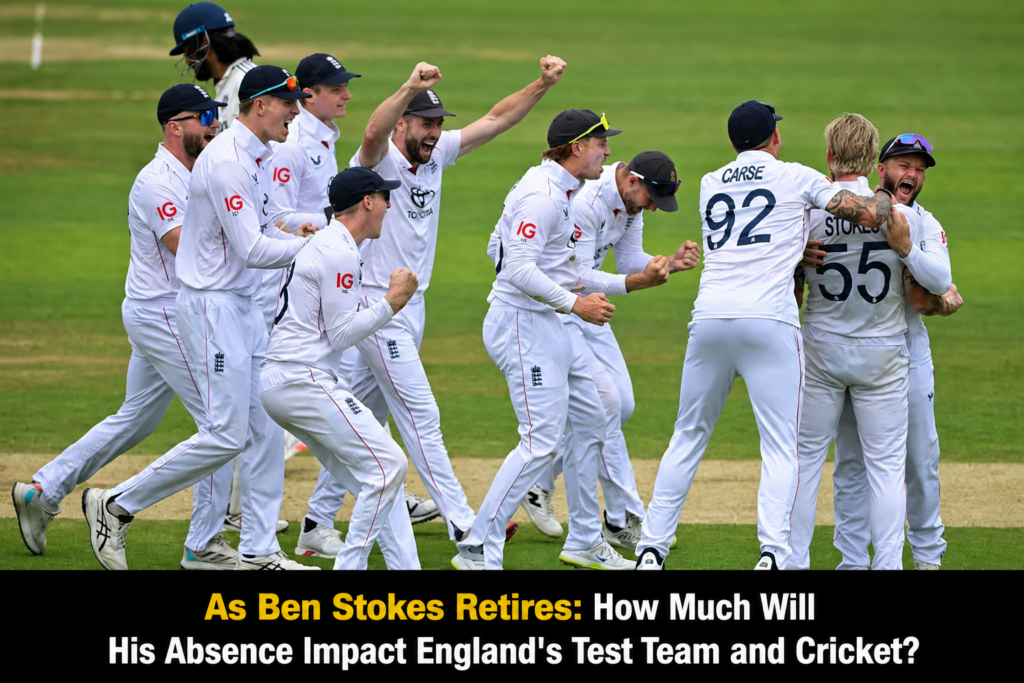
When the announcement landed at Trent Bridge on 28 June 2026, the cricket world did not simply mourn a great cricketer. It began asking a question that no one has a clean answer to: what does England’s Test team actually look like without him? The honest answer is that nobody knows yet, and that uncertainty itself tells you everything about the size of the hole he has left behind.
Stokes Was Doing the Job of Three Men, Not One
Before getting into the specifics of what England lose on paper, it is worth establishing exactly what Stokes meant to this team in practice, because the numbers only tell part of the story.
He was their best bowler over the final 12 months of his career. He was their most trusted batsman when the match was in the balance. He was their captain, their culture, their identity. He was the person who walked out to bat when no one else wanted to, the person who took the ball when the pitch was flat and the partnership was growing, the person who made fielding positions that logic would reject and got wickets from them anyway.
As Cricinfo noted plainly after the retirement announcement, his returns with the bat had declined in recent years, but he had been England’s best bowler over the preceding 12 months and they had missed him badly in their heavy defeat at The Oval the week before. That is the picture. He was not coasting toward a graceful exit. He was still doing the heavy lifting. That is what England have now lost.
England Have No Clear Next Captain and the Clock Is Ticking
England’s immediate problem is not philosophical. It is practical. They do not have an obvious next captain.
When Stokes stepped down from the 2022 New Zealand series midway through the Oval Test due to disciplinary grounds, Joe Root stepped in as interim captain. That stopgap measure worked in the short term, but it was never a long-term plan. Root, for all his immense quality as a batsman and a senior voice in the dressing room, had already served as England captain from 2017 to 2022 and stepped down from the role. Asking him to return permanently would be to reach backwards at a moment when English cricket desperately needs to build forwards.
Harry Brook is vice-captain and is widely viewed as the long-term successor. The ECB managing director Rob Key has acknowledged that Brook has more learning to do before the role is formally his. That assessment was made more complicated by Brook’s own off-field issues during the winter, which made his candidacy for an immediate handover awkward. The timing could hardly be worse.
So England face a captaincy vacancy at the precise moment when they also need to rebuild their identity, manage the tail end of the Bazball era, and prepare for a 2027 Ashes series in England that was supposed to have Stokes at its centre. Two candidates, neither straightforwardly available, and a void left by a captain who had a second-best win percentage of any England Test captain behind only Mike Brearley. That is a hard act to follow by any measure.
The Philosophy Survives, But the Man Who Made It Work Is Gone
Bazball was always more than a tactic. It was a temperament, and the temperament had a face. That face was Ben Stokes. When the approach worked at its best, it was because Stokes embodied it more completely than any other player in the team. His batting intent set the tone. His bowling aggression backed it up. His presence in the field communicated to the opposition that no lead was safe and no target was beyond reach.
The numbers tell a sobering story. Since the bright early days of the Bazball era, when England won nine of their first ten Tests, the results have become increasingly uneven. England went 33 Tests from the start of the second World Test Championship cycle and won 16, losing 15. They lost 4-1 to India in India. They drew their home series against India 2-2. They lost the 2025-26 Ashes in Australia 3-1, going down in the first three Tests before salvaging a result in the dead fourth game.
The bold philosophy that looked revolutionary in 2022 began to expose itself against the very best opposition. England’s batting strike rate leapt from 48.1 in the pre-Bazball era to 70.7 under McCullum, a remarkable shift, but against India and Australia the bowling could not regularly take 20 wickets. The win percentage against India and Australia was roughly half what it was against all other opponents.
Stokes was central to the times when it worked beautifully. Without him, the next phase of the philosophy will require either a genuine evolution or a rethinking of what England’s Test cricket wants to be. The approach can survive, but not unchanged, and not led by someone still finding their feet in the captain’s role.
England Cannot Replace a Number Six Who Also Took 230 Test Wickets
England’s Test lineup has been built around the assumption that Stokes would contribute both with bat and ball. Remove that assumption and the mathematics of selection change significantly. At his peak, he effectively gave England a five-man bowling attack while batting at six. That means England could carry an extra batsman in their top order, confident that Stokes would add genuine wicket-taking threat with the ball to complement the four specialist seamers.
Without him, England must ask whether any individual can offer even a fraction of that combination. The honest answer is no. Not because there are no talented all-rounders in English cricket, but because Stokes was operating at a level that placed him in the company of Sobers and Kallis. You do not replace that profile. You reconfigure around its absence.
The team that takes the field in the next Test series will have to decide whether to play an extra specialist bowler or an extra specialist batsman, because the luxury of a player who credibly fills both roles no longer exists. That is a seismic shift in how England build their playing eleven.
England Had Won Just Two of Their Last Nine Tests Before He Even Left
It would be wrong to suggest Stokes is leaving England in rude health. He is not. England going into the Trent Bridge Test against New Zealand had won only two of their previous nine Tests. They were heading into a fourth-innings chase of 373 at the point of the announcement, having lost four wickets in 15 overs on the fourth evening. The series was slipping from them with or without the retirement news.
The broader context is that Bazball has had mixed results for some time, and the dressing room has had its share of off-field turbulence during this summer alone. The culture that Stokes built with such care over four years is under pressure not just from the loss of its architect but from the accumulated weight of results that have fallen short and incidents that have tested the environment he tried to create.
This is not Stokes’s failure. A captain can only control what he can control. But it means England cannot simply swap out their captain and expect the trajectory to improve automatically. Something deeper needs addressing.
Test Cricket Loses the One Man Who Made Casual Fans Stop and Watch
The impact of Stokes’s retirement is not limited to the England dressing room. Cricket at large loses something significant as well.
He was one of the most watched players in the world. In an era when the attention of audiences, particularly younger audiences, is fiercely contested between franchise T20 tournaments and the demands of social media, Stokes was one of the few Test cricketers whose mere presence in a match made people stop what they were doing and watch. The Headingley 2019 match was watched by millions more people than would ordinarily tune in for an Ashes Test on a Monday afternoon. The 2019 World Cup Final generated coverage that crossed far beyond cricket’s usual audience, and his name was at the centre of it.
Test cricket needs those players. It needs people who make the format feel urgent, who remind an audience raised on franchise cricket why the five-day game is worth four hours of their evening. Stokes did that better than almost anyone else of his generation. His retirement is a loss not just for England but for the format he played in and the game he loved.
Root, Brook, and a Bowling Attack That Must Now Stand on Its Own
None of this means English cricket is in terminal decline. It is not. The raw material is there. Joe Root remains one of the finest batsmen in the world. Harry Brook, whatever his off-field complexities, is a generational batting talent in the making as a captain. Gus Atkinson has the makings of a fine pace bowler. Ben Duckett and Zak Crawley give the top order genuine intent.
But these players now need to find a way to carry the team without the safety net that Stokes provided. They need a captain who can lead through form slumps, through tough tours, through the kind of scrutiny that a post-Bazball England team is going to face on every front. And they need a bowling attack that can be penetrative without the crutch of Stokes delivering ten overs at real pace on a flat pitch when no one else is breaking through.
Whether that is a temporary adjustment or a longer rebuilding period depends entirely on who steps into the captaincy, how quickly they establish their authority, and whether England’s management can articulate a clear direction in the absence of the man who was that direction for four years.
The Gap He Leaves Is Not the Shape of One Cricketer
The question posed at the start of this piece was: how much will Stokes’s absence impact England and cricket? The answer, as objectively as one can offer it, is: enormously, and across multiple dimensions simultaneously.
They lose their best all-rounder. They lose a captain with a win percentage bettered only by Mike Brearley among all England Test captains. They lose the embodiment of a playing philosophy. They lose the player who turned up for the biggest moments and delivered when no one else could. They lose the figure around whom an entire generation of cricket fans built their relationship with Test cricket.
Cricket will carry on. England will find a way. New heroes will emerge, new moments will be written, and the sport will not stop for anyone. But the next Ashes cycle, the next rebuilding phase, the next generation of England cricket, all of it begins in a world without Ben Stokes in the middle. It will take years before anyone fully understands what that means.
The gap he leaves is not shaped like one cricketer. It is shaped like everything he was.

Lucky Raina is a complete cricket writer chasing corporate dreams by day and cricket stories by night. Once a promising Under 16 cricketer, life took him down a different pitch but the love for the game never left.