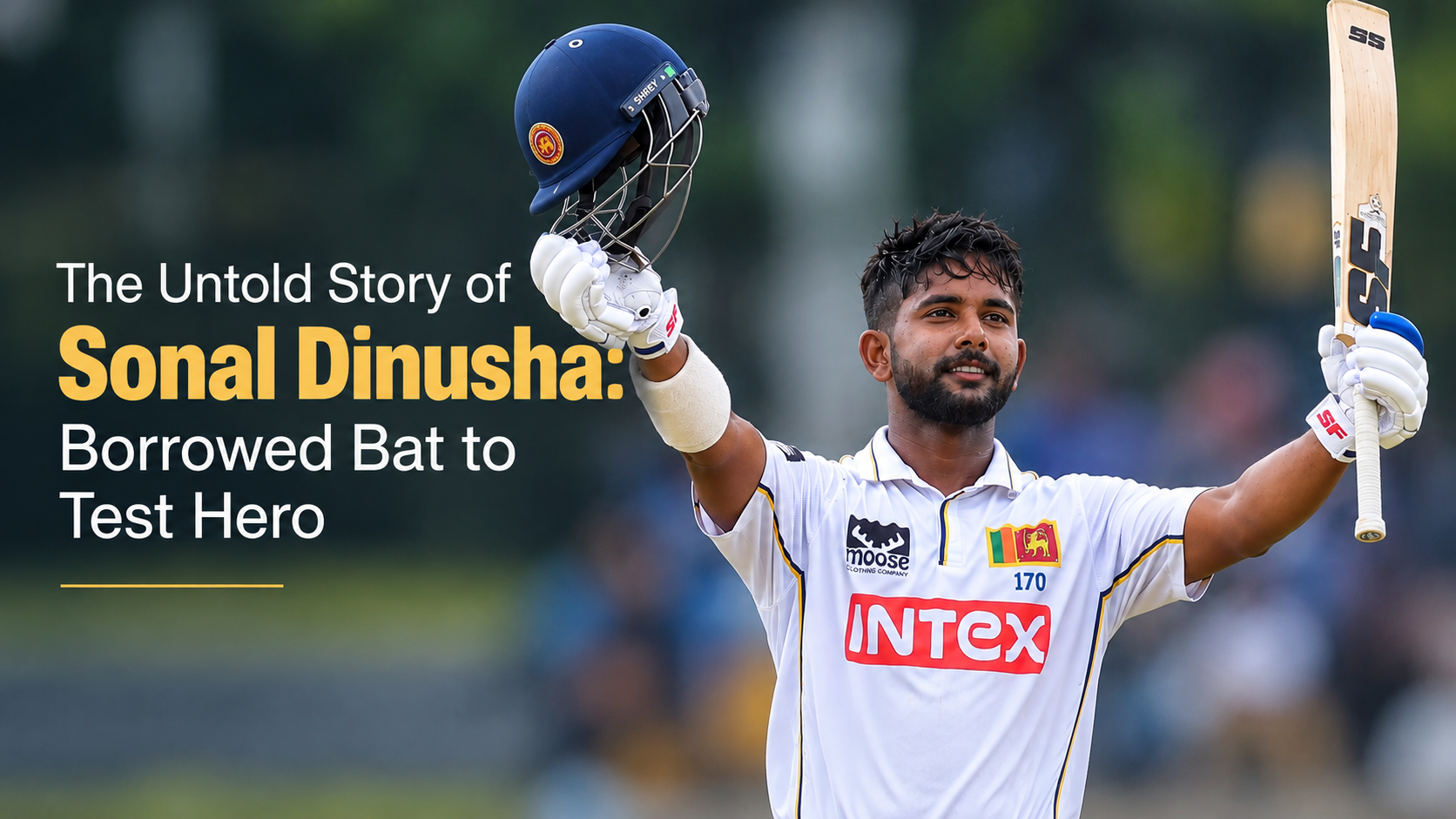
Every few seasons, Test cricket produces a player nobody outside the domestic circuit saw coming. In August 2026, that player was Sonal Dinusha. A left-handed batting all-rounder who had spent seven years grinding through Sri Lanka’s first-class system, he walked into a home series against India with a single Test fifty to his name and walked out of it as the leading run-scorer of the series, the man who stopped India from completing a 2-0 sweep, and arguably the most talked-about young batter in the subcontinent.
Here is the full picture: where he came from, what he actually did against India, and why his sweep shot has become the most discussed stroke in Sri Lankan cricket.
Who is Sonal Dinusha?
Gamage Sonal Dinusha was born on 4 December 2000 in Colombo, Sri Lanka. He is a left-handed batter and a slow left-arm orthodox bowler who plays as an all-rounder, and he has represented Sri Lanka in Test cricket since 2025. ESPNcricinfo lists his playing role specifically as a batting all-rounder, and his teams include Sri Lanka, Colombo Cricket Club, Dambulla Sixers, Galle Titans, Sri Lanka A and Sri Lanka Under-19s.
A quick snapshot of his profile:
- Full name: Gamage Sonal Dinusha
- Born: 4 December 2000, Colombo
- Batting: Left-hand bat
- Bowling: Slow left-arm orthodox
- Role: Batting all-rounder
- Domestic sides: Colombo Cricket Club, Galle Titans, Dambulla Sixers
- Test debut: 25 June 2025 vs Bangladesh, at the SSC in Colombo
Where did Sonal Dinusha come from?
His route into the Sri Lanka side was not a fast-tracked one. He began his school life at De La Salle College in Colombo, where he initially played basketball before turning to cricket. He represented the school at Under-13 level, progressed through the Under-15 and Under-17 teams, and later captained the school side. In 2015 he was awarded De La Salle College Colours for cricket, and he subsequently moved to Mahanama College.
The financial side of it was never easy. Dinusha grew up in a humble background without the resources that make a cricket career straightforward, but from a young age he showed a determination to make a career in the sport. At the Colombo Cricket Club, coach Sonal Dulshan Alwalage became a central figure in his development. That partnership has now run for 13 years, with Alwalage continuing to mentor young cricketers at the club.
What is interesting is that his early identity was not as a batter at all. Like many young cricketers, Dinusha first made his name as a bowler and developed into an effective left-arm spinner, but over time it became clear that his batting could take him much further.
The milestones came steadily rather than dramatically. He made his first-class debut for Colombo Cricket Club in the 2018-19 Premier League Tournament on 30 November 2018, followed by a List A debut in March 2019. In January 2020 he was named in Sri Lanka’s squad for the Under-19 Cricket World Cup, and he made his Twenty20 debut on 4 March 2021. At that U19 World Cup, played under captain Nipun Dhananjaya, he scored 122 runs in six games at an average of 30.50 and a strike rate of 96.82, with Sri Lanka losing the Plate final to England.
How did he break into the Sri Lanka Test side?
Domestic runs did the talking. Before his international debut, he had built a reputation on the domestic circuit as a genuinely balanced all-rounder, with thousands of first-class runs and more than a hundred first-class wickets to his name. He made his official Test debut against Bangladesh on 25 June 2025 at the Sinhalese Sports Club ground, and then played twice more in the Test series against the West Indies, where he narrowly missed out on a maiden Test hundred.
So the setup going into the India series was modest. Before facing India, Dinusha had just a single half-century in his entire Test career. Four innings later, that record looked completely different.
What did Sonal Dinusha do against India in 2026?
This is the part that turned him into a headline name. Batting mostly in the lower middle order, usually following captain Dhananjaya de Silva, Dinusha produced a string of high scores that repeatedly rescued Sri Lanka from collapses. He became only the third player in Test history to score 80 or more runs in each of his first three Test innings against India, joining West Indies great Everton Weekes and Pakistan legend Zaheer Abbas. He then added centuries in both innings of the second Test in Colombo.
His series read like this:
- 1st Test, Galle: an unbeaten 100 in the first innings and 84 in the second
- 2nd Test, Colombo (SSC): 103 in the first innings and an unbeaten 133 in the second
- Series total: 420 runs at an average of 140, finishing as the leading run-scorer of the series
His maiden Test hundred, that unbeaten 100 off 168 balls at Galle, came as part of four consecutive half-plus scores, and he was comfortably Sri Lanka’s standout performer across the series. what people will remember. Cramping and exhausted but refusing to give in, Dinusha scored an unbeaten 133 off 264 balls and combined with Sri Lanka’s tail to script a draw at the SSC, with his father watching from the stands. It was his third century of the series and his second of the match, and Sri Lanka batted through the entire fifth day after being forced to follow on. When the players shook hands, Sri Lanka were 429 for 9 after 154 overs in the second innings.
The physical cost was brutal. He batted for 420 minutes in Colombo’s heat and humidity, cramping repeatedly, struggling with his hamstring, needing constant attention from the physio, and often kneeling at the non-striker’s end as the innings wore on. India captain Shubman Gill summed it up afterwards, saying “He didn’t give us even half a chance.”
The draw meant India still took the series 1-0, but it dented their push towards the 2027 World Test Championship final.
Why is his sweep shot such a big deal?
Because it is not a flourish, it is a system. The sweep has been Dinusha’s most productive stroke, especially on pitches where spinners dominate. It is not something he picked up after reaching international cricket. He has worked on it since childhood, spending long hours repeating it in the nets, with training sessions stretching two to three hours and the sweep getting particular attention.
Against India, that preparation paid off directly. Facing a spin-heavy attack, he countered with sweeps and reverse sweeps to register his maiden century. His technique and his willingness to keep going to the sweep are now central to how he scores runs.
Just as important is his decision-making. His development was built around adaptability, technique and game awareness, and he learned to read situations quickly rather than simply attack every ball. That is the difference between a promising domestic batter and a Test batter who can survive day five.
What do the numbers say?
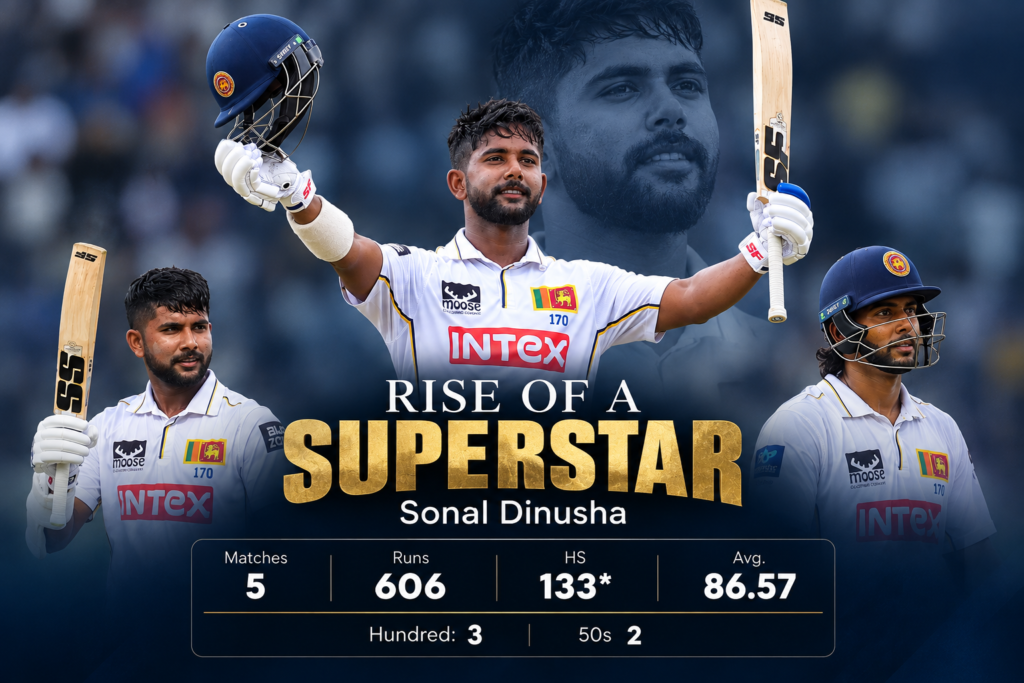
As of late August 2026, his Test record showed 5 matches, 606 runs at an average of 86.57, with 3 hundreds and 2 fifties, a top score of 133 not out, and 6 wickets at 53.50 with a best of 3 for 22. His first-class record stood at 70 matches, 4,118 runs at 48.44 with 14 hundreds and 20 fifties, plus 133 wickets at 28.24 including seven five-wicket hauls and two ten-wicket matches, with best figures of 8 for 67.
The first-class numbers are the ones to keep an eye on. A batting average close to 50 alongside 133 wickets is a genuinely rare combination, and it explains why Sri Lanka were comfortable slotting him into the lower middle order rather than treating him as a specialist.
Has he played ODIs or T20Is?
Not yet at international level. Dinusha is still to feature in an ODI or a T20I, though his form in the longest format has made a white-ball call-up look increasingly likely. He did turn out for Dambulla Sixers in the most recent Lanka Premier League, playing two games and scoring eight runs.
What comes next for Sonal Dinusha?
The obvious challenge is doing it away from home. Sweeping spin on Galle and SSC surfaces in front of a home crowd is one skill set. Facing seam movement in England, New Zealand or South Africa is another, and that is where his technique will get properly examined.
The second question is his bowling. His first-class bowling average of 28.24 is far stronger than his current Test bowling average of 53.50, which suggests there is a second string here that Sri Lanka have barely used. If he develops into a bowler captains trust for long spells, he stops being a batter who bowls and becomes a genuine Test all-rounder, which changes how Sri Lanka can build a side around him.
For now, though, what he did in August 2026 stands on its own. A 25-year-old from a modest Colombo background, coached by the same man for 13 years, swept and grafted his way through four innings against the best spin attack in world cricket and came out with 420 runs and a draw that his team had no business securing.

Lucky Raina is a complete cricket writer chasing corporate dreams by day and cricket stories by night. Once a promising Under 16 cricketer, life took him down a different pitch but the love for the game never left.