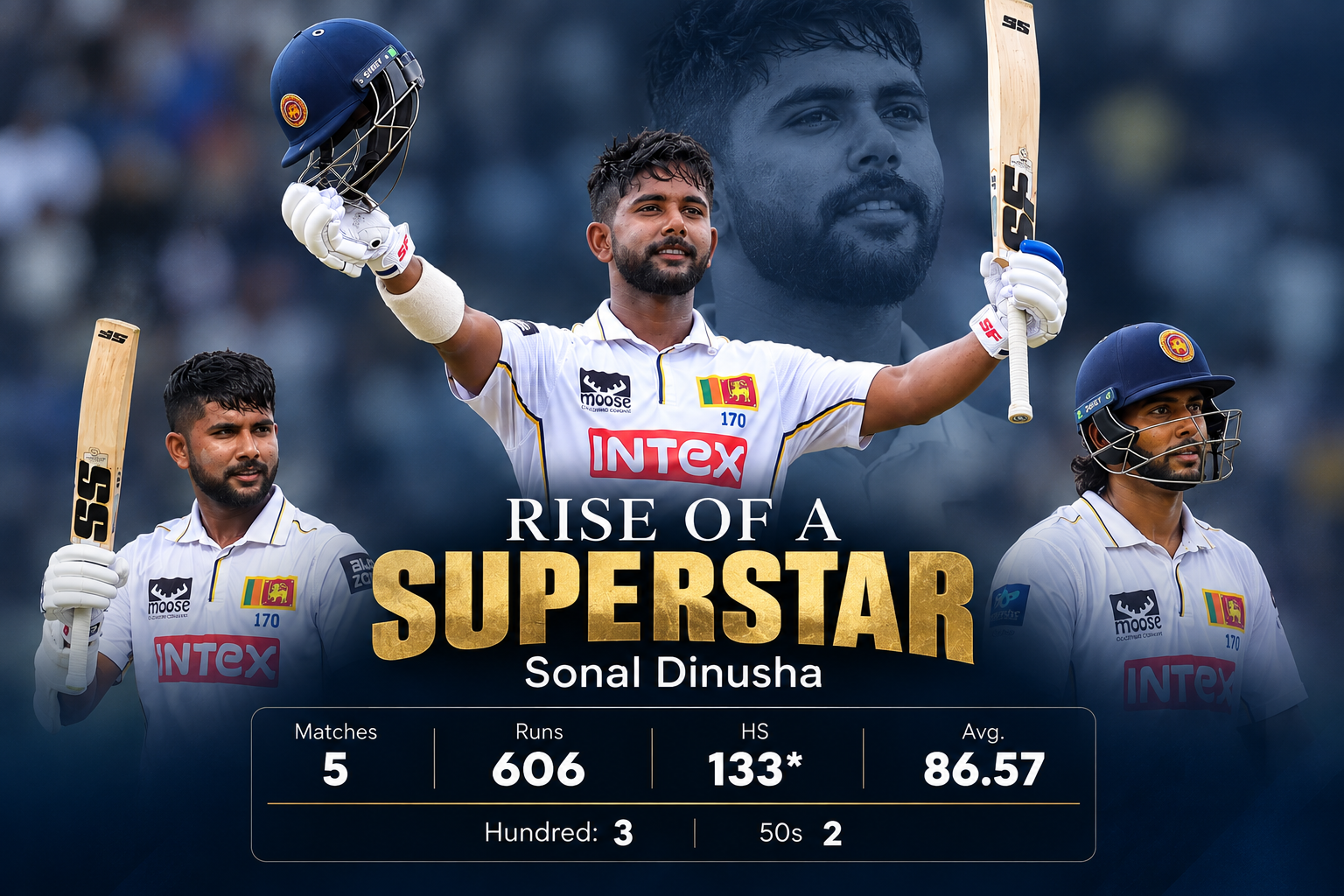
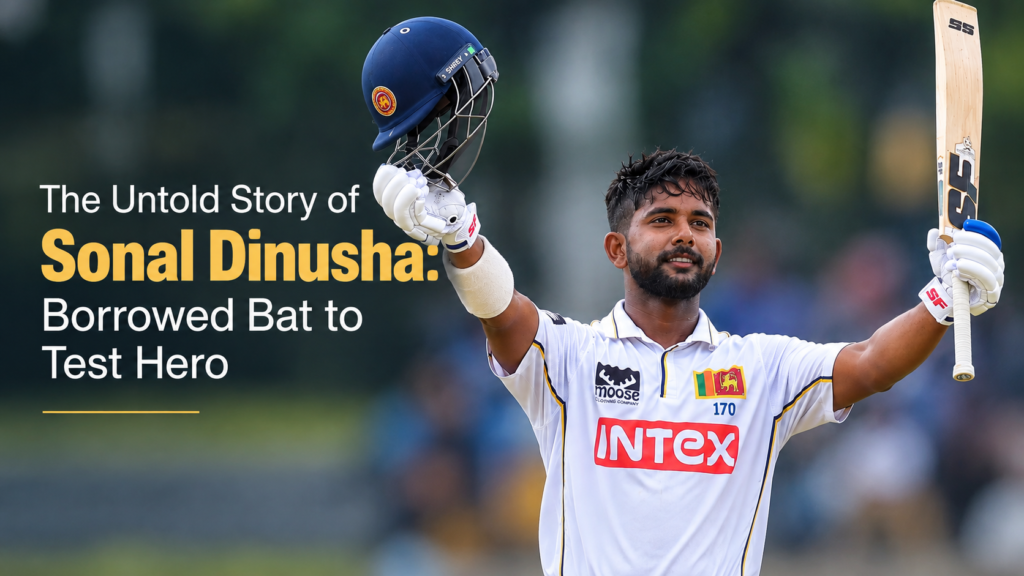
The scorecard from Colombo in August 2026 tells you that a 25-year-old Sri Lankan left-hander batted for 420 minutes, finished unbeaten on 133, and stopped India from winning a Test they had already half-won. What the scorecard does not tell you is that the boy who played that innings did not own a cricket bat until his sister borrowed money to buy him one.
This is the part of Sonal Dinusha’s story that did not make the highlights reel.
How did a basketball kid end up with a cricket bat?
Dinusha’s first sport was not cricket. Like many children in Sri Lanka he was drawn to basketball and trained at it seriously, and it was only when his school coach Susantha Felix Dias watched him playing cricket casually that he was pulled into the school cricket team. At that stage he had no bat and no gear of his own.
The solution came from inside the family. His sister borrowed money to buy him his first cricket bat, because the household simply did not have the funds. Coach Ashan Priyanjan, who has known him since he was a schoolboy, told PTI that whatever the family earns now comes through Dinusha, and that it is their only income. Priyanjan also described how attached Dinusha is to his father, mother and siblings, and suggested his attachment to cricket runs along the same lines.
That detail reframes everything about the Colombo innings. Priyanjan’s view is that Dinusha leaned on cricket as an escape from the poverty at home. The sport was never just a career plan. It was the way out.
ALSO READ: All You Need to Know About Sonal Dinusha
Who actually built Sonal Dinusha?
Not one coach but a chain of them, and they arrived at different stages.
- Susantha Felix Dias, the school coach who moved him from basketball into the cricket team in the first place
- Ashan Priyanjan, who first saw him at 11 or 12 when the De La Salle school side trained at Colombo Cricket Club, and who still takes a phone call from him before every single match
- Sonal Dulshan Alwalage, who took him on at Mahanama College and has now worked with him for 13 years, and who is today a Level 2 coach with Sri Lanka Cricket
Priyanjan’s memory of the 11-year-old is that his enthusiasm and dedication stood out even then. Alwalage’s description of him is warmer still. He calls him humble and hard-working, says a tough childhood keeps his feet on the ground, and adds, “Now, he is like a member of my family.”
Alwalage also has a story that explains the batter Sri Lanka ended up with. At 19, playing for Mahanama against Richmond College in Galle, Dinusha came in with three wickets already down and made 159. What impressed the coach was not the size of the score but the maturity around it: rotating strike, picking which bowlers to attack, choosing gaps in the field, and shielding the tail-enders long enough for Mahanama to win on the first-innings lead.
If that sounds familiar, it should. Six years later at the SSC he did exactly the same thing at Test level, farming the strike alongside Lahiru Kumara, Prabath Jayasuriya and Keshara Nuwantha to drag Sri Lanka to safety.
Where did the sweep shot really come from?
Everyone who watched the India series noticed the sweep. Very few people know it was assigned to him.
Priyanjan told him, years ago, that he would need a reliable sweep if he wanted to succeed against spin, because a career in Asia would be built on turning pitches. Dinusha’s response was to go to the nets and practise that one shot for around two hours at a stretch. Not as a phase, but as a habit he carried into adulthood, with sessions stretching to two or three hours and the sweep always getting the most attention.
The 2026 series turned that investment into cold numbers. Of the 420 runs Dinusha scored across Galle and Colombo, 173 came from sweeps, which took him past Joe Root’s 160 for the most runs scored via the sweep against spin in a Test series.
What happened in the week before the India Test?
This is the part that shows how he thinks.
A few days before the series began, Dinusha called Priyanjan. The conversation was short and entirely practical: India were bringing every variety of spin, so he needed to prepare properly. Priyanjan says he gets a call like this before every game.
They went to the Colombo Cricket Club and built a session around the problem. Priyanjan brought in off-spinners and left-arm spinners while Dinusha spent hours on his sweep and reverse sweep. The results showed up directly against Ravindra Jadeja, Kuldeep Yadav, Manav Suthar and Saransh Jain.
So when Dinusha swept India out of a Test match, it was not improvisation under pressure. It was a rehearsed answer to a question he had already identified.
Has he done this before?
Yes, and there is a lesser-known example from Australia. Former Sri Lanka batter Avishka Gunawardene, who worked with him on a Sri Lanka A tour, recalls Dinusha struggling badly against the short ball in Darwin while the Australian quicks worked him over.
Instead of hiding from it, Dinusha asked Gunawardene to arrange extra net sessions specifically against short-pitched throwdowns. In the next two unofficial Tests he made 105 and 88. Gunawardene’s reading of it was that the problem-solving instinct, and the maturity to ask for help with a weakness, is what separates him from most players his age.
That is a pattern, not a one-off: identify the weakness, build a drill around it, come back with runs.
What did the Colombo draw actually cost him?
More than most people realised while watching. Dinusha cramped repeatedly through the final session, struggled with his hamstring, needed constant attention from the physio, and was frequently seen kneeling at the non-striker’s end as the innings dragged on.
The context makes the effort even starker. The draw was only the fourth time in Sri Lanka’s history that they had saved a Test after being asked to follow on, and the first since the 2010 Galle Test against the West Indies. They had been asked to follow on 27 times before, losing 24 and drawing three. The projected odds were roughly 88.89 per cent for defeat and 11.11 per cent for a draw.
India’s captain Shubman Gill put it plainly afterwards: “He didn’t give us even half a chance.”
What did he do after the Test ended?
He asked to go back to the nets.
Within hours of saving the Test, Dinusha called Priyanjan and said he wanted to train at CCC on the Friday, because he had a Major League 50-over match for the club on 31 August and a T20 league in the first week of September. Priyanjan told him to rest after a series of that intensity. Dinusha’s answer was that the series was over and he now wanted to help the club win its matches.
That single exchange probably explains his career better than any statistic in this article.
Why does the club still matter so much to him?
Because he never left it. Dinusha joined Colombo Cricket Club at 18 and stayed long enough to become a senior figure there, and he now captains a side that includes international players such as Dhananjaya de Silva, Kamindu Mendis, Vishwa Fernando and Asitha Fernando. Priyanjan says everyone in that dressing room respects him because they have all seen his commitment up close, and he is convinced that Dinusha will captain Sri Lanka one day.
There is a neat image in all of this that says everything. While Dinusha was batting for Sri Lanka at the SSC, Alwalage was a few hundred metres away at the CCC nets, taking a session with the next group of young cricketers, focused on the boys in front of him rather than the television.
What is the real story here?
The untold story of Sonal Dinusha is not really about twin centuries or a record number of sweep runs. It is about a family that could not afford a bat, a sister who borrowed money anyway, a school coach who moved a basketball player across to cricket, and two coaches who kept a talented kid in the game when finances could easily have pushed him out.
It is also about repetition. Two hours of sweeping, over and over, for years, on the advice of a coach who could see what Asian pitches would demand. Extra sessions against the short ball in Darwin because the Australians had found a weakness. A phone call before every match.
Sri Lanka did not discover a batter in August 2026. They collected on 13 years of work that almost nobody outside a Colombo club ground had been watching.

Lucky Raina is a complete cricket writer chasing corporate dreams by day and cricket stories by night. Once a promising Under 16 cricketer, life took him down a different pitch but the love for the game never left.